
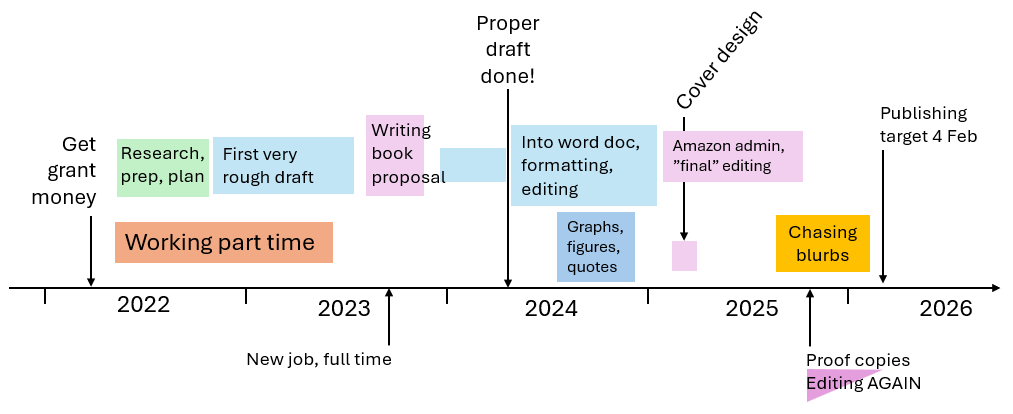
I really mean it this time. For the last few years, these yearly summaries are the only things I’ve published on this once-much-more-active blog. I’m writing my book Competitive Sensemaking, which I got a grant to write back in 2022. Optimistically it looked like I could’ve finished it in 2023, I definitely feel I should’ve in 2024. In 2025 I finally did, kind of.
Writing a book takes a long time when you work full time at a regular job (which I’ve done for 2+ years since my grant money and ran out and I couldn’t work part time any more) and have kids and a lawn and everything. This last year, like the year before, I’ve been away to cafés on a number of Sundays, written on lunch breaks and train commutes, and even managed to read through and edit a paragraph here and there while my SQL queries were running at work. Baby steps.
A year ago I described the book as being “on the cusp” of being ready, and it was. Only the final stuff left, like cover design, index, front matter, Amazon publishing procedures, getting ISBN etc. And I did all that! I got through it during the first half of the year. Then, of course “just one more round” of editing, which took until October because reading a whole book very carefully takes more time than you expect.
Then I ordered proof copies! I was so excited to see it all in print! Weirdly Amazon refused to them send home to me because they won’t ship non-retail orders internationally for some reason, so I had to order them from Germany, to friends there, and have them send them to me. A month after first trying to order them I finally had them in my hand. What did that mean? You guessed it, another round of editing, because things just feel different in print than on a screen. November/December went to that.

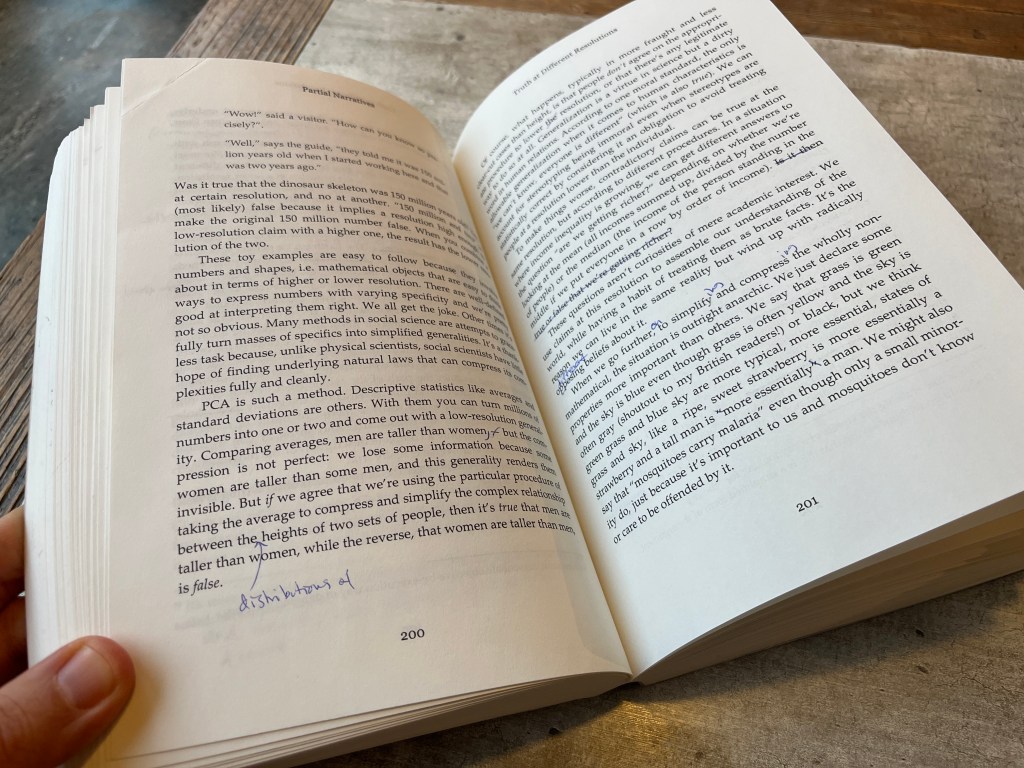
It also meant I had no reason to put off that most awkward of all things: soliciting blurbs. I contacted some people, about a dozen, who I knew would or thought might be positive, and asked them if they’d read and maybe endorse it. I got a few “no”s but most agreed to receive the manuscript, which was nice (even the no-ers where kind about it). First I thought I could get away with publishing in December because I had my heart set on publishing in 2025 because I couldn’t bear writing another one of these “not ready yet” end-of-year reports. But here I am. It became obviously impossible to do it that quickly, not only because I had to give the blurbers enough time, but because the final round of editing wouldn’t be ready in time either.
Now I’m planning, hoping, to push it out on February 4th. That means my timeline will have looked like this:
The oldest material adapted from blogposts will be close to ten years old. It does feel like this book should have come out five years ago, and now conventional wisdom have caught up somewhat. There’s much more awareness now of how the current communication landscape, social media in particular, makes us develop separate, incompatible understandings of reality, compared to when I developed most core ideas in Competitive Sensemaking back in 2016-2018. If I were to put a positive spin on that, maybe that means it’ll be more easily digestible?
Showing the manuscript to others also caused a bit of a crisis of confidence. One of my prospective blurbers was concerned about me not trying very hard to get traditionally published (I only sent the book proposal to a few agents). My book was so important, he said, that I really should dust off my proposal and try more, and also that my starting chapter lacked urgency and clarity about what the book is really about — and that things like that is what a professional editor could’ve told me.
Hm, maybe he was right, maybe I was doing it all wrong?
*Personal crisis*
After a few days I came to the conclusion that, given how low the chance is that a nobody like me with an abstruse book like Competitive Sensemaking could get traditionally published, and that even if I could manage it, it would mean a long delay, and I’d probably have to do my own marketing anyway since I’m no celebrity, and given all the horrible things I’ve heard about the modern publishing industry… putting more effort into that felt very low expected value. So I’m not doing that. The truth is, even if it succeeded it would mean a lot of decision-making power would be taken out of my hands, and having that power is a big, essential part of what keeps me going. I’m not making money on this (ok I got a grant and a modest Patreon income that I’m grateful for, but in terms of hourly wage this whole enterprise is a disaster), and what makes it worthwhile is the fact that I, unlike in my regular job, get to call the shots. All of them. Every single word and pixel is my own effort. Take that away and there’s not much in it for me anymore.
I did take his point about pacing to heart, especially since another one of my blurbers enjoyed it but also said it takes a while to understand what it’s about. I’m in no position to restructure things now, because everything fits together like a jigsaw puzzle. And I will not, and never would have, changed it into something more airport-book-like in terms of having an easily explained message to sell in six seconds. It’s a cluster of many messages, all introduced and established one by one, creating a web of references to each other. I cannot write any other way. I cannot write in a way other than what I enjoy, which makes sense to me, and is interesting to me… not when the main motivation is my enjoyment and self-actualization. Is it possible that Competitive Sensemaking will actually do good, and achieve its stated objective of improving public discourse? Or make me some money? Yes, if the right people like it and spread the word, but the mere possibility was not enough to keep me engaged for years, so what you’re getting is what I enjoyed writing.
However, too much creative solipsism is bad, so I did what I could to make it easier to digest, and added an introduction, a few pages long, before the first chapter, telling the reader what to expect. Here it is, as a teaser:
Prelude: What You Are About to Read
Any respectable book must have a thesis. This does have one, but it is not one simple enough to be captured in an elevator speech. It is designed to slowly accustom you to a certain way of thinking, one that requires many interlocking components who need each other for their full significance to be apparent. I will go through them in turn, later pieces building on earlier in an increasingly dense web, like a novel where parallel stories eventually come together. It tells us how disagreement works, as in how and why people have different beliefs, and what happens when they negotiate them.
Thinking about the philosophical and psychological complexities of disagreement has been unnecessary for the great majority of us who don’t engage in theoretical discussions on a daily basis. But this has changed. Now everybody has a voice, the voices can reach each other, and with that have the capacity to cultivate their differences, and to access any intellectual resource they need to do so, from the writing of tenured academics to those of schizotypal cranks.
The resulting diversity is beautiful, in a way, but also causes problems, including but not limited to toxic political polarization, social disintegration, and decay of trust and goodwill, as empathy requires both comprehension and charity. We have old, venerable conventional wisdom of how to have civilized discussion and debate, but it is increasingly irrelevant. There’s a notable absence of awareness what people disagreeing in public actually do instead of behaving like formal debaters — because it’s definitely something else. Rather than throw up our hands at the everyman’s eternal failure to behave like a philosopher’s ideal just because he is exhorted to, we should seek to understand what is really happening, and why.
There is method to the madness: if people are debating badly, what are they doing well? The first step to treatment is diagnosis. Public disagreements have become vastly more complex in recent decades (for reasons explained in chapters 2 and 3) and require more competence to navigate. Such competence, I believe, comes from internalizing some insights. “Competitive sensemaking” is a two-word description of what public disagreement, discourse, and “debate” actually is. Sensemaking is the process by which we turn a vast array of unorganized concrete details about the world into stories and belief systems that we can comprehend and use. We also like these stories and belief systems to support us and our friends in our social and political goals — that’s the “competitive” part.
Sensemaking uses a range of philosophical, social, and psychological mechanisms that are not logical argumentation. A key element for understanding it is that language differs entirely from the reality it supposedly depicts, which throws a wrench into simplistic notions of true and false. Another is the multifaceted, yet foundational role linguistic ambiguity plays in rhetoric. Also, it cannot be understood without considering that coordinating around shared belief systems for power is a core function of building and maintaining them.
Under these conditions, communication would be difficult enough if all people were alike, but we are not. We subscribe to different, incompatible, often mutually incomprehensible belief systems partly because we perceive the world differently on an intellectual, emotional, and even physiological level. Add to the mix a subconscious mind with ulterior motives we don’t notice, and the side effects of having social instincts made for navigating a small, local social circle but now confronted with an endless mass of disembodied potential friends, rivals, and enemies, and then you have, well, today.
Think about what you are about to read as a gymnast’s vault, where the first third is all run-up, the middle jumps off the spring-board and flips over the vault table, and in the last third we’re spinning in the air and — hopefully — stick the landing.
I should be thrilled after all this time. Three, almost four years since I started putting it together, and ten years (today!) of writing about these topics online — the very first post here on Everything Studies was January 6th 2016. But I’m worn, and in an awkward balance between wanting to get back to writing shorter pieces again, which I feel should be easier after this gauntlet of unrewarded, feedbackless work, and wanting to get away from it all. I have a Substack to continue at, like everybody else (I’m double publishing this on the regular old blog and the Substack), and I’m excited about that yet intimidated by how much competition there is hustling insight, compared to back in the 20-teens when I wrote most of the foundation of Competitive Sensemaking. A lot have changed, even since 2022 when I got the grant. Part of me wants to push this out, wash my hands and take a long break from everything instead of having to step up. But I also know that’s bad. Given how much time I’ve spent on Competitive Sensemaking, I should do all I can to promote it, pitch related pieces to outlets and whatnot, and then build on the platform the book creates to keep exploring ideas that interest me (and perhaps even do good). Having to think about it all, intensely, for several years, has helped clarifying what’s interesting to explore further. If I know myself, I’m unlikely to be able to stay away.
Publishing in early February is a good idea, according to ChatGPT, which (who?) says that late winter is the best time for books like it. And I’m nervous. I am quite satisfied and proud of it, but there’s risk a of crashing and burning if it’s not a success (whatever I should count as “success”). Historically, there’s not a straightforward relationship between how proud/satisfied I am with something and how popular or well-received it is by others. That makes sense of course, it’d be strange if, when I spend years writing about something, it wasn’t the case that I’m much more interested in the topic than almost everyone else is. I’ll do what I can to make it not an anticlimax.
Barring an unexpected turn of events, Competitive Sensemaking will be out in a month. Be sure to check it out! If you like it, tell everyone! (Honestly, if you hate it, maybe tell everyone as well, all publicity is good publicity.)
Here’s the table of contents:
Competitive Sensemaking: An Update to Common Sense on Disagreement
TABLE OF CONTENTS
Prelude: What You Are about to Read
Part I: Groundwork
1 A Tale of Two Realities
2 Popular Erisology
3 Dysfunctional Disagreement
4 The Postmodern Condition
Interlude: Fantasia for Two
Part II: Ambiguity for Fun and Profit
5 Kuhn Distortions
6 Cat Couplings
7 Load-bearing Ambiguities
8 Think About Polysemy All the Time
Part III: Bids for Social Reality
9 The Big List of Existing Things
10 Facts, Slogans, and Compounds
11 The Room: Reading and Writing
Part IV: Partial Narratives
12 Artificial Clarity
13 Truth at Different Resolutions
14 Mains and Correctives
Part V: A Society of Minds
15 People Are Different
16 The Political is Personal
17 The Communitarian and Libertarian Intuitions
18 A Bundle of Axes
Part VI: The Political Animal
19 The Enemy Within
20 The Two Faces of Reason
Part VII: Decoupling
21 Decoupling Introduced
22 The Silent Agreement
23 Family and Empire
Coda: The Tower of Recognized Wisdom
Happy New Year!
 Everything Studies
Will there be a way to preorder?
LikeLiked by 1 person
Weirdly they don’t seem to allow that on Amazon for printed books, so not really.
LikeLike
This post spoke to me. Appreciating your actualisation directing you to want to aid civilisation so deeply, and your perseverance in that process of authorship.
Looking forward to the book.
LikeLiked by 1 person